
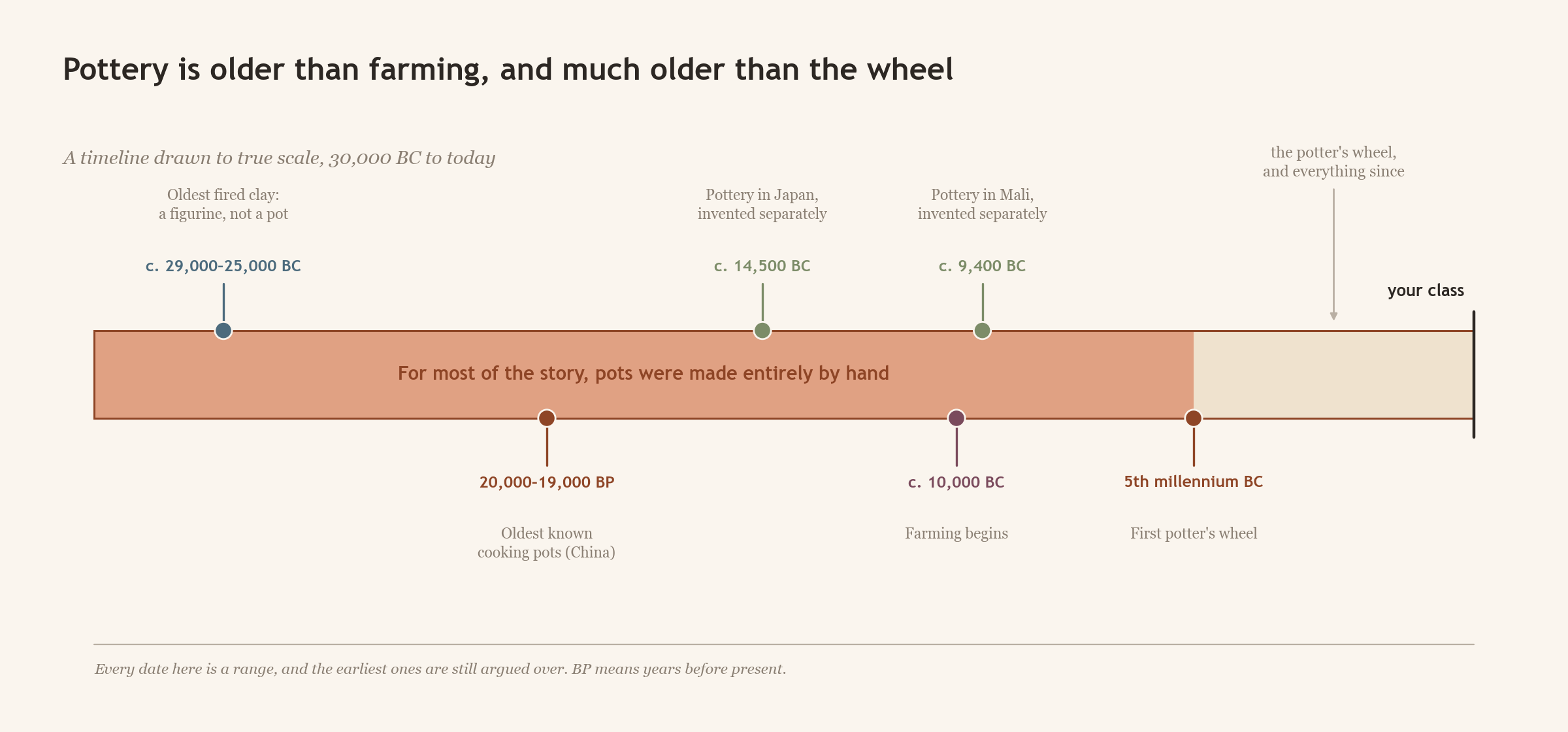
Here is the story most of us carry around. People started farming. Farmers needed jars to hold the grain. So somebody invented pottery, and then somebody set a pot spinning on a wheel, and the craft was up and running. It is a tidy sequence. It also runs backwards at both ends. Clay cooking pots are far older than the first planted field, and the potter's wheel is a latecomer to a craft that was already ancient when it arrived. The order is worth getting right.
Cooking pots from the last Ice Age
In 2012 a research team published findings in the journal Science on pottery fragments from Xianrendong Cave in Jiangxi, southern China. The cave layers holding the earliest pieces date to 20,000 to 19,000 years ago. Nobody was farming anything at that point. The people making these pots were mobile foragers, hunting and gathering their way through the coldest stretch of the last Ice Age, and they were carrying the idea of a fired clay container with them.
Many of the fragments carry scorch and soot marks on the outside, which points to long hours over a fire. These were cooking pots, not storage jars for a harvest that did not exist yet. One caution on the superlative: this is the oldest securely dated pottery so far, not the oldest ever made. Yuchanyan Cave in Hunan is a competing Chinese claim, and some archaeologists have questioned how firmly the Xianrendong pieces tie to the layers that were actually dated.
The oldest fired clay is not a pot
A small ceramic figure from Dolni Vestonice, in what is now the Czech Republic, was fired about 29,000 to 25,000 years ago. It is the earliest known fired clay object, but it is a figurine, not a vessel.
Nobody invented it just once
Pottery did not spread outward from one clever village. Separate groups of people worked it out on their own, with no way of reaching each other. At the Odai Yamamoto I site in Aomori, in northern Japan, burnt food residue stuck to the broken pots dates them to about 16,500 years ago, or roughly 14,500 BC. In central Mali, excavations at Ounjougou produced pottery from at least 9,400 BC, reported in the journal Antiquity. Two inventions of the same object, in two climates, with nothing passing between them.
Farming, for comparison, gets going around 10,000 BC in the Near East. So by the time anyone planted a first field, clay cooking pots had already been in use somewhere on earth for something like ten thousand years.
The pot did not follow the farm. If anything, a person who could boil food in a fireproof container had a head start on everything that came after, from softened grains to rendered fat to water made safer by boiling.
The wheel is the young part
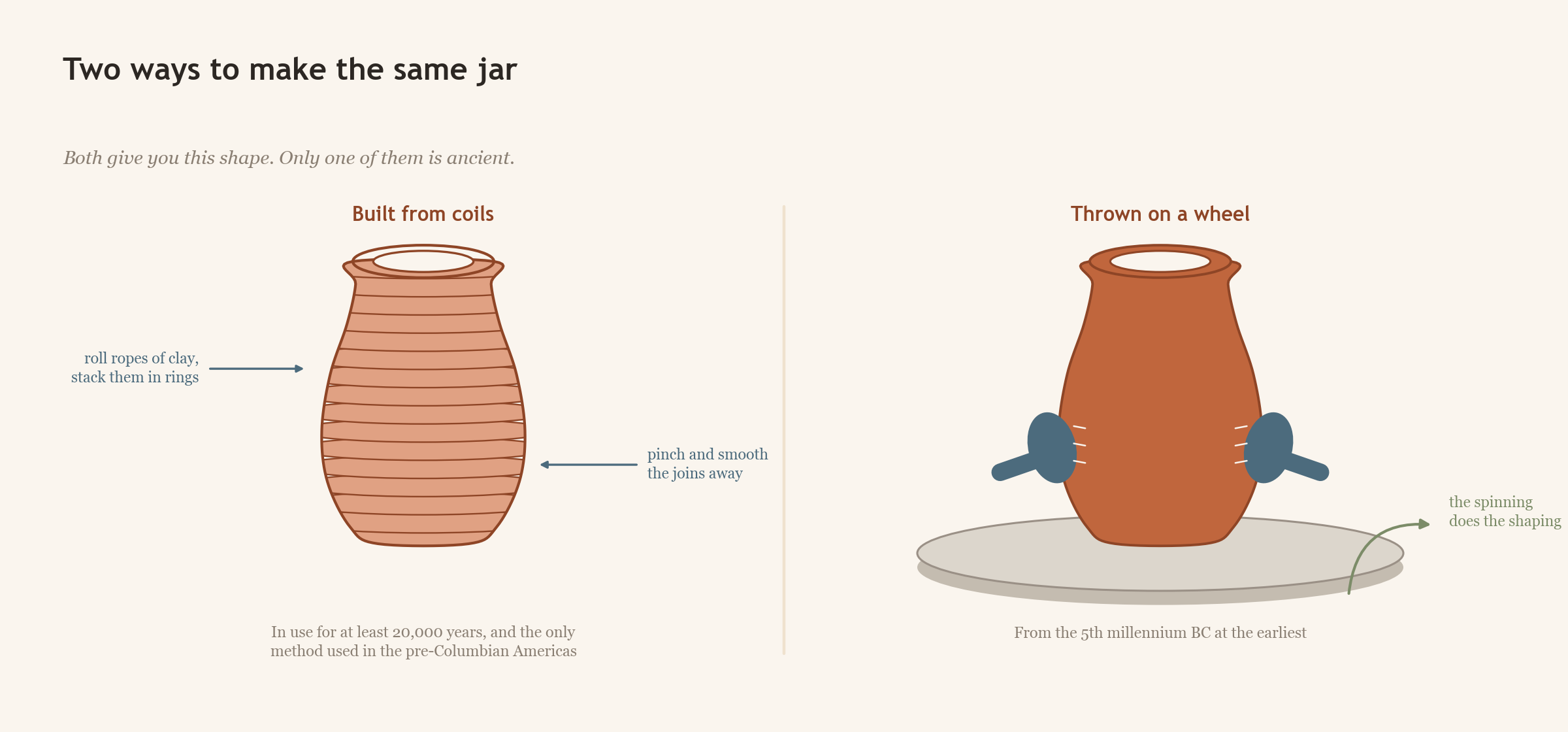
The potter's wheel turns up very late in this story. The earliest examples land in the 5th millennium BC, and the sources disagree about where. Some point to the Cucuteni-Trypillia culture in western Ukraine, around the middle of that millennium. Others name Mesopotamia at roughly 4200 to 4000 BC. A stone wheel from the Sumerian city of Ur is dated near 3100 BC. Take any of those and the gap from the first cooking pots is roughly fourteen thousand years.
An entire hemisphere then managed without one. All pottery made in the Americas before European contact was built by hand: coiled from ropes of clay, pinched out of a lump, paddled into shape, or pressed into moulds. Some potters turned a bowl on a board or a stone as they worked, but the free-spinning wheel arrived with the Spanish. Nobody looking at a Maya vessel or a Nazca jar would call the results a compromise. Coiling never went away, either.
A two-hour drop-in class in Chicago or Miami starts the same way every time, with your fingers pressing cold clay. That part of the craft is twenty thousand years old. The wheel is the recent addition, and it can wait a few minutes.